Each challenge is a chance to explore new ML/AI methods with guidance from advisors and support from your peers. You don’t need to be an expert for your selected challenge—but you do want to pick something where you can grow while still contributing meaningfully to your team. Preview the challenges published so far below. We’re posting the rest as organizers finalize them. Watch the Showcase recording to hear organizer Q&A before you submit your application.
Minimum requirements: All MLM participants are expected to know Python, machine learning fundamentals, and GitHub (enough to collaborate). If you need to get up to speed, please complete the relevant self-paced workshop(s) prior to kickoff: Intro Python, Collaborating with GitHub Desktop, and/or Intro to Machine Learning.
Challenge Showcase recording
Each organizer presents their challenge and takes questions, recorded August 19. The recording is now uploaded and ready to view. Worth watching if you want to hear directly from organizers before ranking your picks. Applications are open now, so apply by August 24 to be included in the first review round, then rolling until seats fill. We aim to admit ~12 applicants per challenge, or 2-3 teams per challenge. See the full schedule.
Badger Code

Summary: Frontier coding agents can read a codebase, plan changes, run tests, and recover from errors – but they’re closed, expensive, and send every keystroke to a third party. In this challenge, you’ll build an autonomous coding agent on an approved open-weight model and score it on Terminal-Bench 2.1, an 89-task benchmark spanning software engineering, debugging, security, and system administration. Everyone works from the same small pool of models (96GB VRAM), so the challenge is the scaffold: the agent loop that tracks context, recovers from failed commands, and knows when the task is done.
Method areas: Agent harness/scaffold design (ReAct-style loops, tool design, planning, self-critique), prompt engineering, local model serving and quantization.
Prerequisites: Comfort writing Python and working in a shell. No prior experience building agents is required, but you must be willing to learn! You don’t need your own GPU either – hosted options are covered for MLM participants.
Badger Scribe
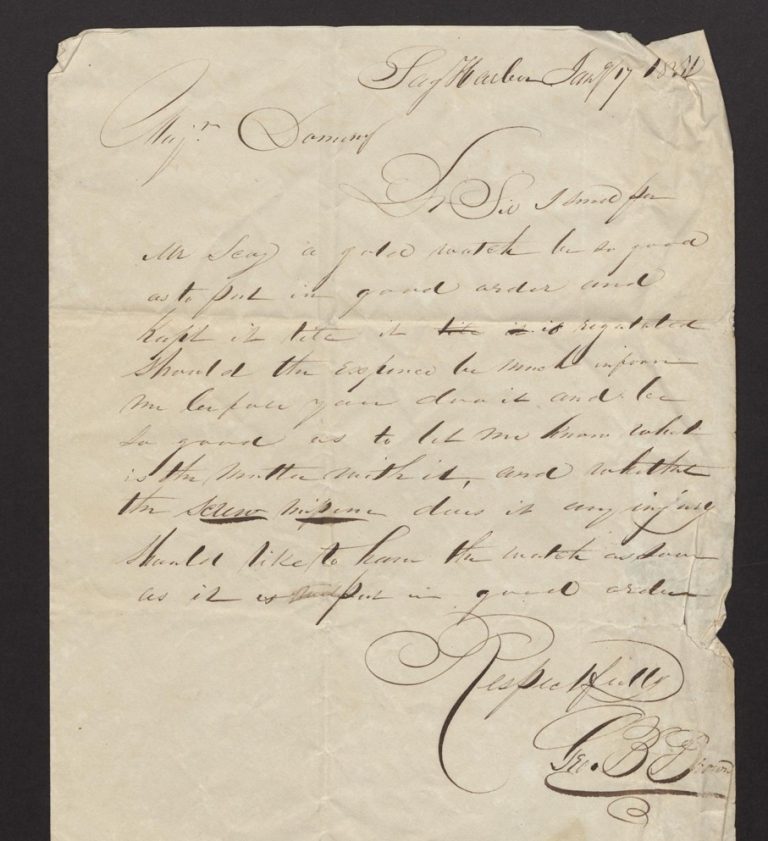
Summary: The UW Libraries hold thousands of digitized archival pages with no transcription at all – surveyors’ field notebooks from the 1830s, German immigrant correspondence in Kurrent script, craftsmen’s account books. Without text, none of it can be searched, read by a screen reader, or studied at scale. In this challenge, you’ll build a pipeline that transcribes archival page images faithfully – verbatim text in reading order, original spelling preserved, no cleanup. Open-weight models only, one GPU.
Method areas: Vision-language models for page-level transcription, traditional OCR/HTR pipelines (layout detection, line segmentation, recognition), optional fine-tuning on auxiliary datasets, evaluation with character error rate.
Prerequisites: No prior experience with OCR, vision-language models, or archival documents is required, but you must be willing to learn! Comfort with Python helps; hosted GPU options are covered for MLM participants.
Brain Decoding: Reconstructing What the Brain Sees
(Coming soon!)
Summary: Can a machine learning model determine what a person is looking at using only their brain activity? In this challenge, you’ll develop models that decode visual information from electroencephalography (EEG) recordings collected while participants viewed hundreds of object categories and natural images. Teams can tackle image classification, object category prediction, or even reconstruct image representations from neural signals using modern deep learning approaches. This challenge offers a unique opportunity to explore the intersection of representation learning, computer vision, and computational neuroscience while working on one of the most exciting frontiers in AI.
Method areas: EEG signal processing, representation learning, multimodal learning, contrastive learning, vision tranformers, diffusion or generative models, transfer learning.
Prerequisites: A working knowledge of Python is expected. Familiarity with machine learning or deep learning will be helpful, but no prior experience with neuroscience or EEG is required. Bring your curiosity, creativity, and eagerness to learn – we’ll provide guidance and baseline code to help you get started.
Snapshot Wisconsin: Oh Deer

Summary: Trail cameras or motion triggered cameras can provide a large amount of invaluable data for ecological research and management. Snapshot Wisconsin has collected over one-hundred million (100,000,000) motion triggered and site photos from across the state of Wisconsin. Aligned with Snapshot Wisconsin goals, a large number of these photos are classified by species and given a few population dynamics tags (like age) from volunteers around the world. However, not all information from images is converted to a structured format. The goal of this hackathon is to predict some of these population dynamic tags, given a labeled dataset supplied by Snapshot Wisconsin.
Method areas: Computer vision data processing pipelines, image detection and/or image classification, vision-language models and other computer vision techniques.
Prerequisites: Familiarity with Python and an understanding of how computer vision prediction models work. No prior experience building computer vision models is necessary. This is a great hackathon to learn and put into action your first computer vision models.
Fixing the Poisoned Well

Summary: You almost never train the models you deploy – weights arrive from HuggingFace, from a past team, from a vendor you trust to work as advertised, and every handoff is a chance for someone to slip in hidden behavior. Backdoors are hard to catch because accuracy stays intact and normal validation passes clean. This challenge puts that audit problem somewhere you can check the answer: a small network predicting streamflow for a Wisconsin catchment, tampered with so it produces water from nothing. Metrics say it’s fine; physics says it can’t be. Find the tampered layer, repair it without degrading the model, and recover the hidden feature the backdoor fires on.
Method areas: Mechanistic interpretability and explainable AI (activation analysis, feature attribution, disentangling superposed features), neural backdoor detection, model surgery.
Prerequisites: No hydrology background and no prior experience with interpretability methods is required, but you must be willing to learn! Comfort with Python and PyTorch helps. The model is small enough to run on a laptop – no GPU needed.
WattBot 2026
Summary: AI systems can consume vast amounts of energy and water, but reliable emissions data remains hard to find and harder to trust. In this challenge, you’ll build a retrieval-augmented generation (RAG) system that extracts credible environmental impact estimates from peer-reviewed sources. Your model must output concise, citation-backed answers—or explicitly indicate when the evidence is missing. The goal: turn scattered academic knowledge into transparent, actionable insights for researchers, engineers, and policy makers.
Method areas: Retrieval‑augmented generation (RAG) workflows using LLMs, optical character recognition (optional) to better parse figures/tables from PDFs.
Prerequisites: No prior experience with large language models (LLMs), RAG, or Hugging Face is required, but you must be willing to learn!